Spare Parts
4 photos
Spare Parts
ISO 9001:2015
Factory Direct
Lifetime Support
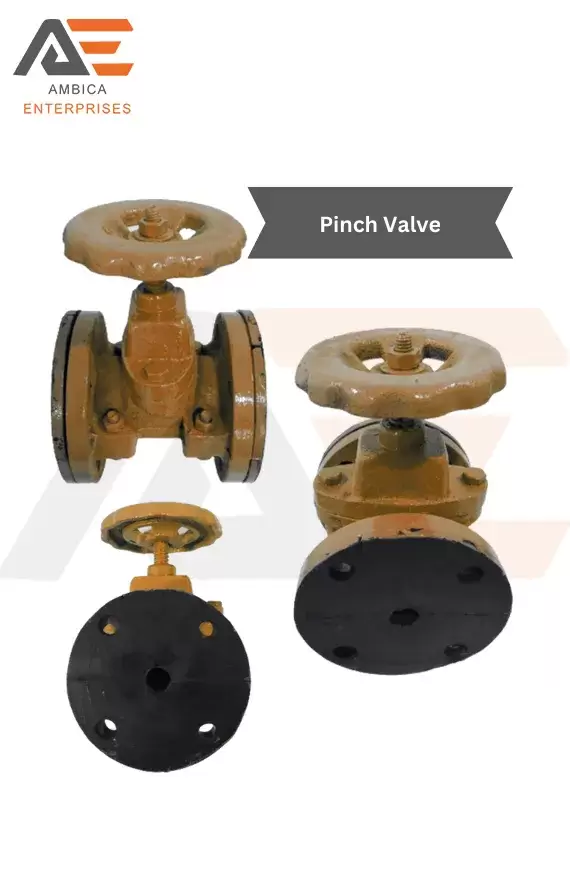
Pinch Valve
Indicative price range
3K - 5K
A Pinch Valve is a two-way valve that is designed to control or shut off the flow of corrosive, abrasive, or granular media. It uses compressed air to open and close the valve.
Brand
Ambica Enterprises
Body Material
Mild Steel
Sleeve Material
Natural Rubber
Pressure
<1.0Mpa
Technical Data
Specifications of pinch valve
Key machine parameters to help you evaluate fitment, throughput, and integration with your production line.
Use Cases
Industrial application of pinch valve
Typical production environments and component types this machine is engineered to support.
Product Overview
Detailed about pinch valve
In-depth technical and commercial information about this machine, applications, and operating advantages.
A Pinch Valve is a two-way valve that is designed to control or shut off the flow of corrosive, abrasive, or granular media. It uses compressed air to open and close the valve. The valve has no restrictions in the open position and allows a wide range of media such as an aluminum oxide to pass through the bore. The valve's flexible internal rubber sleeve isolates the media from the rest of the valve, preventing contamination and damage to the valve's other components. Figure 1 depicts a pneumatic pinch valve.
With slurries and granular products like abrasive garnet sand, cement, gravel, textile fiber, carbon, powder, pellets, chipping, and glass fragments, pinch valves are well suited for use. These valves are desirable in a variety of industrial applications because they are affordable, dependable, and simple to use.
Working of Pinch Valve
The housing, sleeve, and end connections are the pinch valve's three main parts. The only part that comes into contact with the media is the rubber sleeve, which is installed into the housing from the inlet to the outlet. To support and connect to the valve, the end connections are bolted, screwed, or threaded at each end.
Pinch valves can be mechanically or automatically operated with a sand blasting machine. A mechanical pinch valve is a multi-turn valve, which means that it opens and closes by turning the handwheel more than 360 degrees. The valve is typically in the open position. The valve stem lowers as the handwheel rotates. The pinch valve's sleeve is pinched tightly and the flow is stopped when a pinch bar is applied to the middle of the sleeve. Another mechanical pinch valve design has a bottom-up rising and lowering pinch bar.
An automatic pinch valve is powered by a solenoid, hydraulic fluid, or compressed air. Although the three automatic pinch valve types have slightly different operating mediums, the outcome is the same. A pneumatic pinch valve tightens the center of the sleeve by using the air compressor. A hydraulic pinch valve accomplishes the same thing with hydraulic fluid. Finally, a plunger that pinches down the sleeve is moved by an electric current under control by a solenoid pinch valve.
Particles can become trapped around the ball or disc and clog conventional valves like a ball valve and remote control valve. But when the pinch valve opens, the rubber sleeve of the device closes over and traps the particles, allowing them to pass through the system.
The elastic rebounding characteristic of the rubber sleeve, combined with the force of the upstream flow, fully opens the valve when pressure is no longer applied to it. The fully opened valve allows the media to flow freely, preventing clogging or blockage of the valve.
Advantages of Pinch Valve
Because of their elegant designs, pinch valves have the following advantages:
-
Excellent with corrosive and abrasive media
-
Straight flow path and no media clogging
-
Minimal friction and turbulence
-
Prevents microbial contamination of media
-
Low maintenance costs and simple rubber sleeve replacement
-
Superior sealing abilities
-
Brief times for opening and closing
-
A minimal energy footprint
Applications of Pinch Valve
-
Rubber sleeves on sanitary pinch valves are made of nitrile, EPDM, and natural rubber, all of which have received FDA approval for use in contact with food. A pinch valve also cycles quickly, which greatly improves packaging effectiveness.
-
The applications of the chemical industry are numerous. Because there are so many different materials that can be used to make pinch valve sleeve production, pinch valves can handle many of these applications.
-
In order to handle solids and bulks, pinch valves provide the necessary abrasion resistance. Solids cannot clog the valves because of their full-bore opening.
Pinch Valve Manufacturer
We are a worldwide leading pinch valve manufacturer and we offer commercial goods to customers and clients everywhere. With a user-friendly website that enables you to order all of your industrial supplies and ships them quickly anywhere in the world, we work to live up to our motto, "We Simplify Industrial Supply." Ambica Enterprises strive to become a leading manufacturer of all industrial products, our product line includes air operated shot blasting machine, airless shot blasting machine, sand blasting helmet, sand blasting nozzles, sand blasting hose, remote control valve, thermal spray gun, arc spray gun, metalizing wire and abrasive media like steel shots, glass beads, aluminum oxide, silicon carbide, copper slag, plastic media and so on.
The Ambica Advantage
Why Buyers Choose Us
End-to-end support from machine selection to commissioning and after-sales service.
Custom Engineering
Configurations tailored to your component size, material, and surface finish targets.
Quality Tested
Pre-dispatch performance checks for blasting efficiency, safety, and reliability.
Export Ready
Documentation and logistics support for domestic and international shipments.
Dedicated Support
Technical guidance for installation, operation, spares, and maintenance.
FAQs
Frequently Asked Questions
Answers about this machine, installation, and support.
Pinch Valve is engineered for 10-15 Days, Box / Bubble Wrapping, Land / Sea / Air, The extreme abrasiveness of a ceramic flow can be handled by pinch valves with reinforced rubber sleeves. within spare parts workflows. It helps remove scale, rust, and contaminants while improving surface profile for coating or further processing. Ambica configures chamber size, abrasive system, and recovery based on your component geometry and daily output.
The typical price range for Pinch Valve is 3K - 5K. Final quotation depends on machine size, automation level, dust collector capacity, and optional accessories. Share your component dimensions and production target to receive an engineering-led estimate with scope clarity.
Yes. Ambica can tailor Pinch Valve for your material type, part size, loading method, and finish requirement. Customization may include table or hanger design, blast wheel or nozzle layout, abrasive recovery, and electrical controls. Our team reviews your sample parts and cycle time before recommending the right build.
Installation planning, foundation guidance, and commissioning support are available for Pinch Valve. We assist with alignment, trial runs, operator orientation, and basic troubleshooting so production can start safely. Remote and on-site support options can be discussed at the time of order confirmation.
After-sales support for Pinch Valve includes spare parts guidance, wear-part replacement schedules, and technical assistance for performance optimization. Our service team helps with abrasive selection, preventive maintenance, and uptime improvement across the machine lifecycle.
Similar Machines
Related Products
Explore more machines from the same category.
 Airless Technology
Mixing Tube
Price Range 2K-3K
- ProductMixing tube
- MaterialMild Steel, Aluminium
- Max. Pressure8 kg
Automotive Components
Foundry Castings
Steel Fabrication
 Air Operated
Soundabrator Valve
Price Range 9K-10K
- ProductSoundabrator Valve
- MaterialMild Steel
- Hardness80HRC
Railway Parts
Marine Hardware
Heavy Engineering
.webp) Heavy Duty
Heavy Duty
Abrasive Blasting Nozzle
Price Range 5-7k
- ProductAbrasive Blasting Nozzle
- MaterialTungsten Carbide, Silicon Nitride
- Size6,7,8,10 mm
Aerospace Components
Valve Bodies
Pipeline Equipment
.webp) Industrial Grade
Industrial Grade
Shot Blasting Wheels
Price Range 10-12k
- ProductShot Blasting Wheels
- Diameter300-525mm
- Powder5-125 HP
Shot Peening Prep
Coating Line Feed
Export Production